
The Quiet Signal: Sihan on Body, Stillness, and WHITE NOISE
Welcome to K. Mag - China Edition
Sihan's issue marks the first international edition of K Magazine.
Celebrating Arts Culture Globally.

Sihan didn't plan to become a photographer. At university in Hangzhou, studying fashion design, she found a second-hand Nikon D90 online for around 1,000 RMB—almost exactly what she'd saved from a part-time job. She bought it on impulse. "I always thought cameras were very expensive," she says, "but one day I found many second-hand cameras for around 1,000 RMB. So I used all my earnings."
She started with landscapes, the kind of images you make when you're still figuring out what you're looking for. Then she started turning the camera onto the people around her. Her fashion design background had already trained her eye in certain ways: she understood silhouettes, fabrics, and how a body occupies a space. That sensibility started bleeding into the photographs.

After graduating, Sihan moved to Hangzhou and started from the bottom with assistant work. She learned on professional sets, watching how other people made decisions under pressure. Four years have passed since then. Now 26, Sihan works as an art director and photographer, and the line between those two roles in her practice is deliberately blurry. Every shoot she directs, she's also composing.
Hangzhou shapes her work in ways she's still working out. The city is genuinely beautiful—old canal towns and wooden architecture sitting alongside glass towers and tech campuses, a skyline in constant negotiation with its own history. The fashion and art scene has grown quickly, which brings both opportunity and a particular kind of pressure. "To some extent, my perspective has been influenced by the market environment," she says. "It is also about survival." She doesn't say this with bitterness. It's just the reality of building a creative practice inside a commercial industry in a city that's moving fast.
But she's been pulling back toward something more personal. Films, images, the work of photographers she admires—she describes it as a gradual process of recalibration, of remembering what she actually wants to say. "In recent years, I have been slowly returning to a more personal creative direction." WHITE NOISE is the most deliberate step in that direction she's taken yet.
"WHITE NOISE originated from my reflection on silence," she explains, "not as emptiness, but as a state filled with subtle signals.”
From there, the question became: what does the body look like when you strip away everything that usually makes it mean something? No strong narrative, clear identity markers, or deliberate use of color. "I became interested in the presence of the body when stripped of narrative and identity," she says. "When color is removed, form and emotion become more visible. I wanted to create images where nothing 'happens,' but something can still be felt."
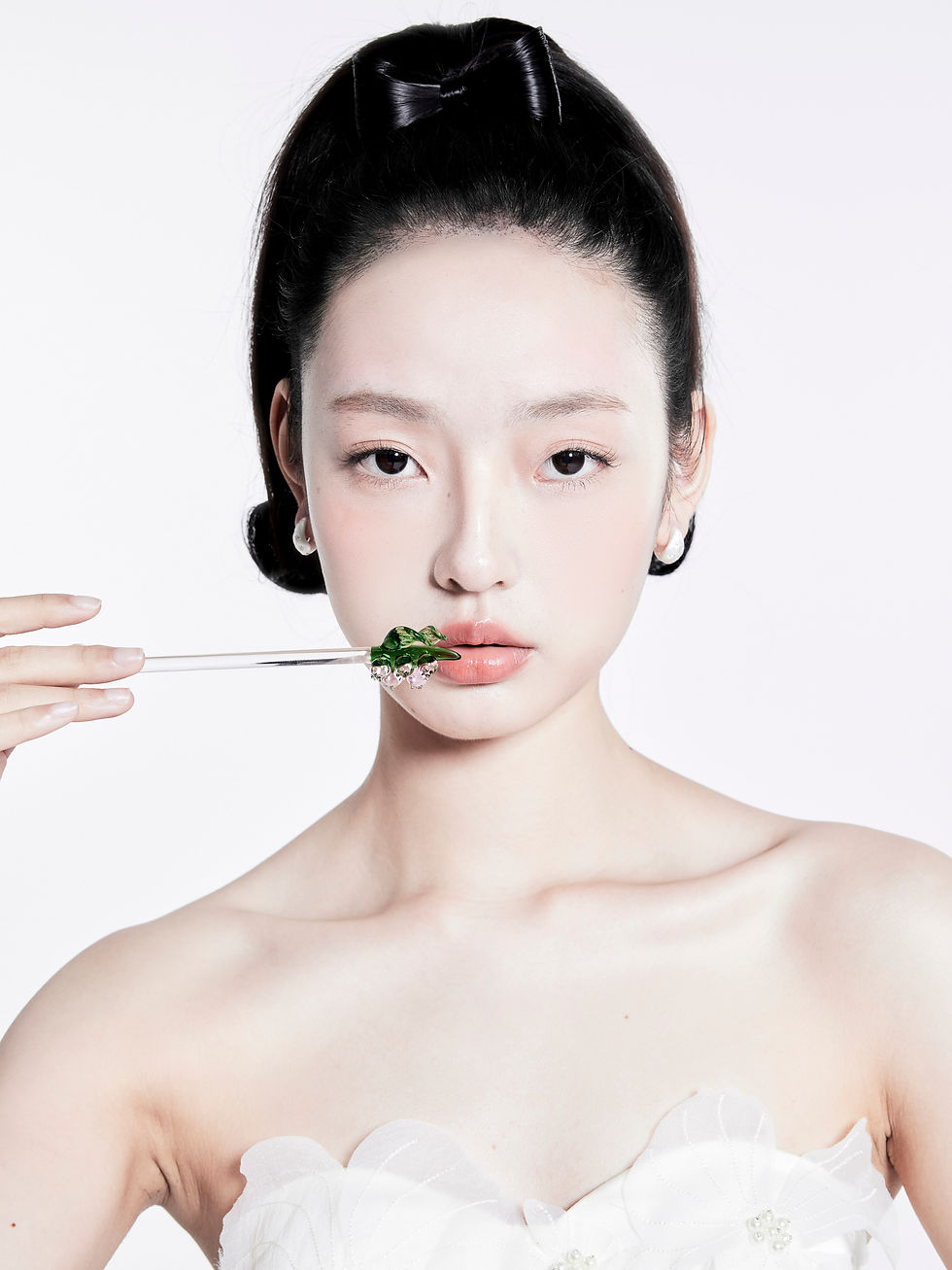
The title holds a tension she's clearly thought through carefully. White noise is ambient and everywhere, and most people tune it out entirely. But Sihan wants to look at it directly. "White is a conceptual strategy to remove distraction," she says, "and the 'noise' comes from subtle differences in light, skin, and posture." The discomfort that creeps into some of the images is very intentional. White noise is calm and slightly unsettling at the same time, and so are these photographs.
The body in WHITE NOISE isn't performing. It isn't selling anything or representing anything beyond its own physical fact. "I see the body not as identity, but as a surface," she says. "By treating it as a canvas, I shift the focus to form and presence rather than narrative. The body becomes something sculptural, something to be observed rather than explained."
It's a genuinely different way of approaching the human figure, especially within a fashion-adjacent context, where the body is almost always in service of something else.
The production was leaner than you might expect from images that carry this much intention. Four people on set total, no assistants, no dedicated lighting technician. Sihan handled both the lighting and the art direction herself. Some ideas could not be fully realized," she says, without making a drama of it. She's grateful to the makeup artist and the friends who stepped in where they could. "They also helped as temporary assistants."

She's worked with stylist Yilei and hair and makeup artist Yu long enough that the collaboration runs on instinct as much as conversation. The concept was locked before they arrived on set— she's not someone who shows up and figures it out—but a lot of what makes the images feel alive happened in real time. "We responded to light and movement," she says. "This unpredictability is part of why I enjoy my work."
The photographers she returns to when the work gets hard are Leslie Zhang, Sangmi An, and Kin Chan, who works under the name Coedel. What she finds in their images is harder to articulate than technical influence. It's closer to proof: proof that the thing she's reaching for actually exists, that someone else has touched it. "Working in this industry often feels like constantly running," she says. "There are moments of exhaustion, but when I see their work, I regain some passion. Their images have influenced both my style and my thinking."
The industry exhaustion she's describing is familiar to anyone who's worked in commercial photography—the relentlessness of it, the way client work and personal work compete for the same finite reserves of energy and imagination. The photographers who survive it with a distinct voice intact are usually the ones who've found something like a north star in other people's work. Something that reminds them, when they need reminding, why they started.
Ask Sihan what she's most interested in exploring and she gives a straightforward answer: emotion and beauty."I hope my photographs will remain engaging even after a long time," she says.

She's equally honest about where she draws the line, for now. More socially or politically driven work—the kind of photography that puts its weight behind an argument about the world—isn't something she's ready to claim. "With my current experience, I may not yet be able to express them deeply." It's a disarmingly self-aware thing to say, especially in a moment when young photographers are often expected to have fully formed positions on everything. She'd rather wait until she has something real to say than reach for a register she hasn't earned yet.
What she has earned, on the evidence of WHITE NOISE, is a way of looking that's genuinely her own. Her images don't explain themselves. Something can still be felt in absence—which is exactly what she was going for.
xoxo, Keertana Sreekumar, Editor


Comments